

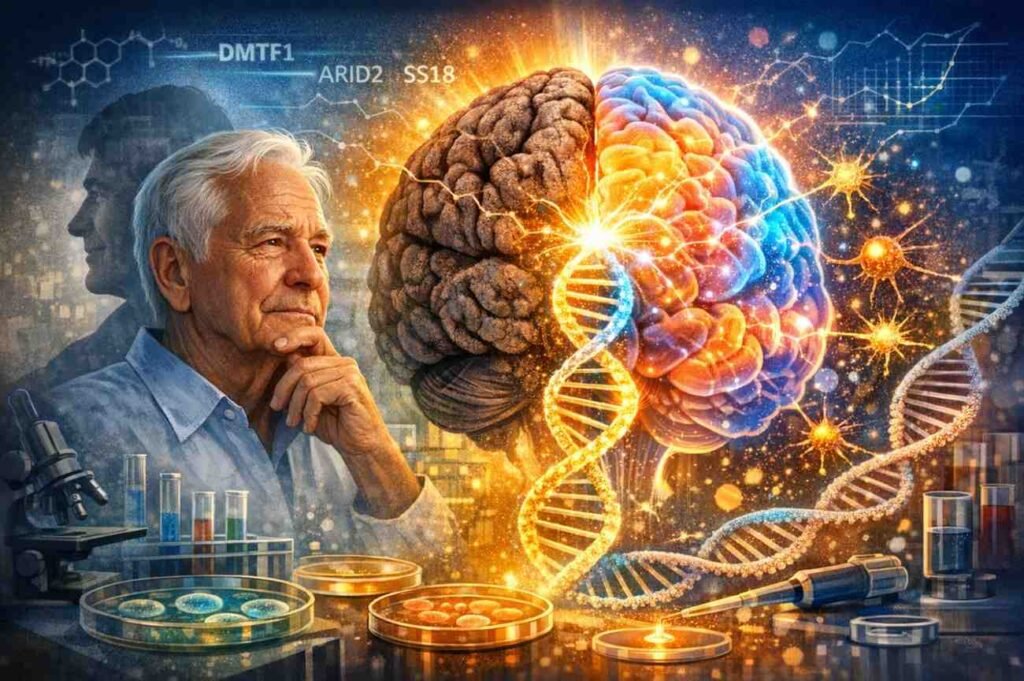
A lot of people who are in my age group (I am 70) get concerned that they are forgetting things. If you’ve ever joked about your brain “not working as it used to,” you’ll want to hear this. Scientists have come across something super hopeful. The discovery of a protein that has reverse brain aging in the lab! For real! Real research from respected scientists. A door that scientists have been trying to unlock for decades
In short, your brain may be more resilient than we ever thought.
(For many a year, I have studied neuroplasticity, neurogenesis, and even new DNA)
🧠 What’s Actually Going On?
We are told that as we age, our brains slow down when it comes to making new neurons. That’s normal, but it’s also one of the reasons learning feels harder; memories get fuzzy, and cognitive decline can creep in over time.
What is this issue created? In the neural stem cells. These are called the brain builders. They are responsible for creating new brain cells. When we are in our younger years, we are very productive. As we age, they slow up, reducing the production. (Neurogenesis is the formation of new neurons, mostly in the hippocampus. It supports memory, learning, mood, and brain repair)
Researchers at the National University of Singapore wanted to know why this happens and, more importantly, whether it could be reversed.
🔑 Meet the Protein That reverse brain aging
Here comes a protein with a long name and big potential: DMTF1.
These scientists have discovered that DMTF1 is much more active in young, healthy brains. In older brains, its levels drop—and that’s when neural stem cells begin to slow down.
This part is exciting. When these researchers and scientists boosted DMTF1 levels in lab-grown human brain cells and in animal models, previously slow or dormant stem cells were awakened. These cells began to divide again and began the creation of new neurons. They behaved as if they were young cells.
And the surprise? It began to work without reversing the DNA damage itself. That meant the protein was doing a workaround rather than turning the clock back at the genetic level.
🧬 Why This Is Such a Big Deal
This protein, DMTF1, doesn’t work alone. It activates two “helper” genes—Arid2 and Ss18—that help unlock tightly packed DNA and turn on growth-related genes. It is as if the brain begins to remember its youth and acts as it did in its younger years.
By doing this, the brain can restart the natural cycle that creates new neurons—something previously believed to be nearly impossible in older brains.
Emily Dickinson was quoted as saying, “I dwell in possibility.” And while this work is only happening in a lab, as there is no pill, injection, or treatment, scientists can point to a specific molecular switch that controls a key part of brain aging.
That’s huge.
🌱 What This Could Mean Down the Road
If this research can continue to confirm these results in humans, this discovery could eventually help scientists:
- Slow age-related cognitive decline
- Support learning and memory later in life
- Develop new treatments for neurodegenerative diseases
- Help the brain regenerate instead of just cope
It is amazing for sure that this is the kind of foundational discovery that future therapies are built on.
💛 The Takeaway
I love stories like this as this research shows that brain aging isn’t just a downhill slide you’re powerless against. It reveals that there are biological systems still capable of bouncing back, even later in life.
I do not see this as immortality or miracle cures—yet. But we are talking about proof that the aging brain still has untapped potential.
It is time for us to begin to be excited about the sciences that are progressing.
